PAR EXCELLENCE AWARD,ICQCC Hydrabad India 2021

Alhamdulilah kali in kumpulan kami telah menerima menerima Par Excellence Award di 46th International Convention on Quality Control Circles (ICQCC) 2021

DIAMOND , GOLD AND SILVER AT IIDEX 2019

Alhamdulilah dari dua projek inovasi yang saya sertai dalam (IIDEX) 2019 kali ini , inovasi WeGBY CHAIR telah menerima Anugerah SPECIAL AWARD - DIAMOND dan GOLD manakala inovasi RDMS (Reference Desk Management System ) mendapat anugerah SILVER

FASILITATOR TERBAIK 2019 ZON TENGAH

Alhamdulilah kali ini di anugerahkan sebagai Fasiltator Terbaik di Konvensyen KIK Peringkat UiTM 2019 Zon Tengah sekali lagi setelah menerima pada tahun 2016

ANUGERAH EMAS KONVENSYEN TEAM EXECELLENT MPC 2018

Alhamdulilah tugasan kali ini berjaya membawa kumpulan KIK PTAR i-Clique meraih Anugerah Emas dalam Konvensyen Team Excellent Peringkat Wilayah 2018 ( Wilayah Selatan ) di Holiday Villa Johor Bahru City Centre

ANUGERAH EMAS BAGI INOVASI SOLAT ALERT SOFTWARE (SAS) DI ITEX2017

Alhamdulilah dapat juga melakarkan sejarah memenangi anugerah emas bagi penyertaan di International Invention, Innovation and Technology Exhibition (ITEX 2017) pula dengan produk inovasi Solat Alert Software (SAS). ....

Anugerah EMAS (GOLD) di Ekspo Reka Cipta, Inovasi dan Reka Bentuk (Invention, Innovation And Design Exposition) - IIDEX

Alhamdulilah kedua-dua projek inovasi yang saya sertai mendapat anugerah dalam IIDEX2016 daripada sejumlah 745 penyertaan keseluruhannya.

Awards at British Invention Show 2009

The British Invention Show, is the largest innovation and technology expo in Britain. UiTM submitted 8 entries of which all won medals.

Fasilitator Terbaik

Fasilitator Terbaik kali kedua berturut-turut. Sebenarnya kejayaaan ini adalah kejayaan anda semua.

Konvensyen ICC Kebangsaan

Naib Johan Sektor Awam, 10 Kumpulan Terbaik Sektor Awam, Anugerah Emas 3 Bintang Konvensyen ICC Kebangsaan

Pingat Emas Dalam Malaysia Technology Expo ( MTE)

Menerima anugerah Pingat Emas dalam Malaysia Technology Expo ( MTE) 2009 yang telah diadakan pada 19 hingga 21 Februari 2009 di PWTC, Kuala Lumpur. Pelbagai hasil penyelidikan telah dipamerkan oleh 460 peserta/ kumpulan daripada pelbagai IPTA, badan swasta, MRSM dan lain-lain organisasi.

Showing posts with label Internet. Show all posts

Saturday, January 12, 2019

Malaysia Internet Users Survey 2018


Malaysia Internet Users Survey 2018
source:
SURUHANJAYA KOMUNIKASI DAN MULTIMEDIA MALAYSIA
Malaysian Communications and Multimedia Commission

The Internet Users Survey (IUS) is an annual survey conducted by Malaysian Communications and Multimedia Commission (MCMC). IUS provides information on the characteristics and behaviours of Internet users in Malaysia, as well as analysis to gauge changes in terms of users’ behaviour and trends.

IUS 2018 reached to a sample of 4,160 Internet users at national level. Respondents were selected at random and all interviews were conducted through Computer Assisted Telephone Interview (CATI) system.

The survey focused on selected key variables including place and device of Internet access, time spent online, purpose of using Internet, social networking and messaging, online banking, parental control services and demographic as well as socio-economics background of Internet users. On top of that, new topic on online content sharing was introduced in IUS 2018.

The survey draws attention to the following findings:

Percentage of Internet users continue to rise – The percentage of Internet users at national level increased from 76.9% in 2016 to 87.4% in 2018.

Smartphone remained as the most common device used to access Internet – Nine out of ten Internet users used smartphone (93.1%) to go online. Meanwhile, the use of fixed and home-based devices such as smart TV, TV streaming box and game console saw a steady increase over the years

Internet has become a pivotal medium in social engagement – Text communication and visiting social networking platform were the most common activities for Internet users (96.5% and 85.6% respectively). WhatsApp and Facebook were the most popular communication and social networking platform

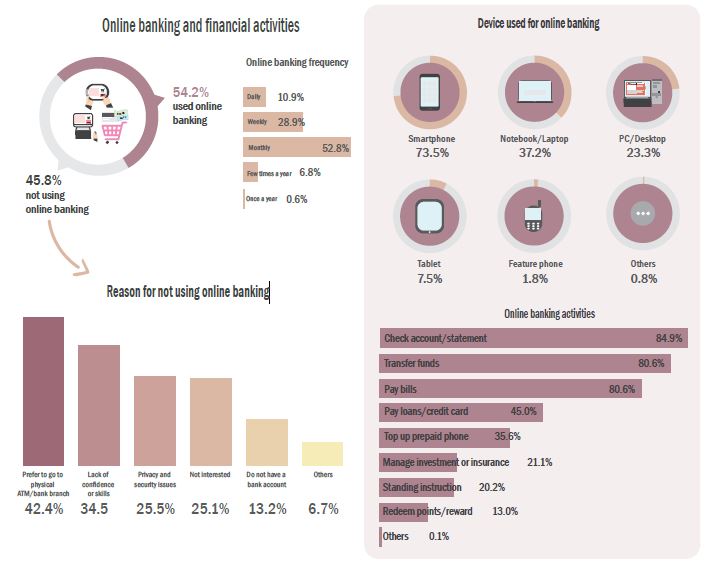
Participation in online banking and financial activities has increased – More than half of Internet users used online banking (54.2%) in 2018, compared to 41.7% in 2016. The main barriers for online banking adoption were consumers’ preference to physical ATM and bank branch, as well as lack of confidence or skills. Checking account/statement and transfer funds were the most common online banking activities

Majority of Internet users had shared content online, particularly among younger users – 61.8% shared content online, with educational content and entertainment/humorous content being the most usually shared content. Most of the content were shared online via social media (73.8%) and group messaging (70.6%). Nevertheless, most of them had taken various actions prior to sharing content online such as understand the content and ensure the content is not obscene, menacing or offensive.

The take-up for parental control services was still low – Only 12.2% of parents amongst Internet users took advantage of the service as an initiative to ensure their child’s online safety. Most parents opted to setting their own rules and limits of Internet usage to their child, as well as staying nearby their child when they were online.


Internet Users Survey 2018 (Infographic)


source: 
https://www.mcmc.gov.my/skmmgovmy/media/General/pdf/Internet-Users-Survey-2018-(Infographic).pdf

Further Reading
Penembusan internet di Malaysia 2015

https://ahmadfaizar.blogspot.com/2015/12/penembusan-internet-di-malaysia.html


Future of the Internet Initiative White Paper
Internet Fragmentation: An Overview

William J. Drake , Vinton G. Cerf,  Wolfgang Kleinwächter, 
The World Economic Forum  , January 2016

Internet Governance Guide for Libraries
https://www.ifla.org/files/assets/faife/publications/ig_guide_chapter_1.pdf

Wednesday, August 15, 2018

Big Data : What happens in an internet minute [Infographic]

This is What Happens in an Internet Minute ?
Apa Yang Terjadi di Internet Dalam Seminit ?


Dalam kehidupan seharian kita , satu minit mungkin tidak kelihatan seperti banyak perkara yang berlaku.

Tetapi apabila kita lihat ke skala luas internet, satu minit masa berjalan lebih jauh daripada yang pernah kita  bayangkan. Itu kerana internet mempunyai tahap skala yang tersangat besar sekarang dimana tak terfikirkan oleh akal fikiran kita haa..haa tak tercapai akal ku...

Tetapi dengan adanya kajian tentang Data Raya (Big Data) yang merupakan satu ledakan informasi yang seiring dengan pertumbuhan ekosistem penggunaan mobile dan data internet.

Pelbagai jenis data berstruktur dan tidak berstruktur daripada media sosial seperti blog, facebook, twitter telah menyokong pertumbuhan Data Raya yang besar, pelbagai, tidak terbatas dan bernilai (volume, variety, velocity, value) sehingga kepada terabytes dan petabyte data. 

2019

Pada 2019 data yang dihantar  sangat besar , setiap minit,
lebih 1, 000,000 pengguna log masuk ke Facebook, dan 
lebih 347,222 pengguna skrol menerusi Instagram. 

Di samping itu, 41.6 juta mesej dihantar antara pelbagai individu di WhatsApp dan fb


https://www.weforum.org/agenda/2019/03/what-happens-in-an-internet-minute-in-2019

2018


Pada 2018 data yang dihantar  sangat besar , setiap minit
lebih  973,000 pengguna log masuk ke Facebook, dan 
lebih 174,000 pengguna skrol menerusi Instagram. 
Di samping itu, 38 juta mesej dihantar antara pelbagai individu di WhatsApp.

Semua itu hanya sekilas gambaran yang lebih besar - lihatlah infographic di bawah untuk mendapatkan lebih banyak maklumat dan statistik.

This is What Happens in an Internet Minute [Infographic]


Here are the full stats on what happens every internet minute 2016:

    701,389 logins on Facebook
    69,444 hours watched on Netflix
    150 million emails sent
    1,389 Uber rides
    527,760 photos shared on Snapchat
    51,000 app downloads on Apple’s App Store
    $203,596 in sales on Amazon.com
    120+ new Linkedin accounts
    347,222 tweets on Twitter
    28,194 new posts to Instagram
    38,052 hours of music listened to on Spotify
    1.04 million vine loops
    2.4 million search queries on Google
    972,222 Tinder swipes
    2.78 million video views on Youtube

    20.8 million messages on WhatsApp


Yang pasti merek / syarikat-syarikat ni yang kaya


#bigdata #internet  #InternetMinute #GoOnLine


source

https://www.visualcapitalist.com/what-happens-in-an-internet-minute-in-2019/


https://www.socialmediatoday.com/news/this-is-what-happens-in-an-internet-minute-infographic/524426/

https://medium.com/world-economic-forum/what-happens-in-an-internet-minute-4feb0235cbf

http://www.visualcapitalist.com/what-happens-internet-minute-2016/


http://blog.atwork.at/post/2018/06/13/This-is-What-Happens-in-an-Internet-Minute


https://twitter.com/hashtag/internetminute


http://www.visualcapitalist.com/tech-giants-visualizing-profits-for-every-10-seconds/

Monday, December 21, 2015

Penembusan internet di Malaysia


Malaysia di tangga keempat

MALAYSIA mampu menempatkan diri dalam kedudukan tangga keempat dalam Indeks Internet Mampu Milik 2015.
Putrajaya is concentrating on 95% Web protection with the concentrate on rural areas by 2020, stated Communications and Multimedia Minister


Servis tidak setanding bayaran

PADA hari ini, internet menjadi medium perhubungan dan komunikasi penting kepada masyarakat tanpa mengira latar belakang.

Kita menjadi hamba kepada internet kerana kepentingannya, dunia tanpa sempadan dan maklumat hanya di hujung jari.

Kita seolah-olah tidak boleh hidup tanpa internet dan segelintir tidak boleh menerima kenyataan hidup tanpa internet, sepi.

Internet menjadi pilihan kerana elemen kepantasan merentasi seantero dunia dalam menghebahkan maklumat terutamanya di media sosial seperti facebook, instagram, twitter, blog dan laman web.

Mengakui kepentingan internet bagi sebuah negara maju, dan sewajarnya seiring dengan perkhidmatan terbaik  pada harga berpatutan.

Malaysia dilihat terkebelakang dalam perkhidmatan internet berbanding negara jiran seperti Thailand dan Singapura.

Pengurus Pemasaran dan Perhubungan Awam Denai Hati Network Sdn Bhd, Hisyamudin Fadzil berkata, setakat ini, Telekom Malaysia Berhad (TM) yang menyediakan perkhidmatan jalur lebar berkelajuan tinggi, Unifi adalah terbaik dan capaiannya adalah 20 megabait sesaat (mbps) dengan caj yang dikenakan melebihi RM100.

Berbanding capaian internet di Singapura adalah 500 mbps ke satu gbps dan Thailand pula adalah 44 mbps ditambah syarikat-syarikat telekomunikasi (Telco) di negara tersebut menawarkan pelbagai pakej.

“Kita tidak mencapai tahap diimpikan iaitu capaian pantas dengan kadar pembayaran berbaloi. Jika negara jiran, dengan capaian kelajuan internet yang sama, tetapi harga dikenakan lebih murah,” katanya.

Di Singapura untuk 500 mbps, caj yang dikenakan adalah S$60 (RM183.60) sahaja berbanding Malaysia 20 mbps bersamaan RM249.

Ditambah mengenai monopoli syarikat tertentu dalam menyediakan perkhidmatan internet, ia adalah isu lama dan majoritinya adalah milik TM.

“Apabila syarikat tertentu memonopoli dan memegang majoriti kawasan liputan, ia dapat mengawal harga kerana tidak ada pesaing boleh menawarkan harga lebih rendah.

TM memegang majoriti laluan telefon dan internet di Malaysia dan memberikan perkhidmatan internet di kawasan liputan tertentu dengan memberikan kepada Telco tertentu sahaja," katanya.

Internet di Malaysia boleh murah atau mempunyai kelajuan sama dengan negara lain jika adanya kerjasama Telco dengan syarikat swasta lain.

“Banyak Telco menyediakan perkhidmatan internet membantu mereka bersaing secara sihat namun liputan kawasan terhad kerana perjanjian atau kontrak tertentu dengan kerajaan, ia akan menawarkan harga lebih murah. Sekarang kabel fiber diperlukan,” katanya.

Untuk menyediakan internet laju dengan harga murah, syarikat Telco perlu meluaskan pasaran liputan, tidak terhad hanya di kawasan tertentu sahaja.
“TM perlu meningkatkan capaian internet dengan menawarkan 30 sehingga 50 mbps tetapi harga ditawarkan agak mahal.

Alasan sering diungkap adalah berkaitan infrastruktur, geografi, muka bumi Malaysia menyebababkan kabel susah nak masuk menjadikan internet tidak dicapai sepenuhnya.

"Pengguna tidak dapat apa yang dikatakan iaitu  internet terbaik di negara ini kerana ia masih tidak stabil dengan keadaan yang sebetulnya,” katanya.

Kawasan di luar Lembah Klang tidak menerima kelajuan internet, purata capaian di Malaysia lima hingga enam mbps masih tidak baik berbanding capaian internet yang baik 50 hingga 60 mbps seluruh negara.

Rasa tertipu, terikat kontrak

Pekerja swasta, Fahd Muzaid Zakaria berkata, berdepan kes bayaran mahal pakej internet yang disediakan syarikat telekomunikasi tetapi mendapat perkhidmatan tidak seperti dijanjikan adalah perkara biasa.

Sudahlah berdepan tahap kelajuan internet perlahan tetapi bayaran mahal. Jika mahu hentikan perkhidmatan tersebut perlu menghabiskan kontrak yang dimeterai sebelum ini.

“Keadaan ini seperti tertipu. Aduan yang disuarakan kepada syarikat penyedia perkhidmatan internet untuk memotong perkhidmatan yang digunakan tidak dapat dilaksanakan kerana terikat dengan kontrak sebelum ini,” katanya.

Menggunakan beberapa perkhidmatan internet sebelum ini menghadapi pengalaman sama apabila bayaran dikenakan tidak berbaloi namun perkhidmatan yang disediakan perlahan.

“Pelbagai janji ditabur untuk menjual produk. Kita akan tertarik dengan janji manis namun hampa apabila ia tidak seperti dijanjikan.

Walaupun penggunaan data internet tidak seberapa, namun kuota yang digunakan cepat habis, malah bil diterima akan tepat pada masanya,” katanya.

Bagaimanapun, kerana kepentingan internet pada masa kini menyebabkan dia tiada pilihan dan terpaksa menggunakan data internet daripada syarikat Telco yang dianggap terbaik padanya.

Bagi pekerja swasta, Norlida Shaari, rata- rata pengguna mengadu liputan perkhidmatan internet dan data daripada syarikat-syarikat telekomunikasi bermasalah serta mengalami kesukaran menghubungi perkhidmatan pelanggan syarikat tersebut walaupun menggunakan talian tetap.

Masalah perkhidmatan internet atau data syarikat telekomunikasi seperti Celcom Axiata Bhd (Celcom), Maxis Bhd (Maxis) dan Digi Telecommunications Sdn Bhd (Digi) serta Yes menjadi topik bualan di laman sosial.

“Biasanya, sekejap ada internet ni, sekejap tidak ada. Terpaksa tutup dan buka semula telefon mudah alih untuk mendapatkan internet. Kadang-kadang saya berada di sebuah kawasan liputan syarikat Telco yang saya guna, malangnya capaian internet tetap perlahan.

“Ada kawan-kawan saya pernah terkena dengan sebuah Telco. Pembelian kuota internet lima GB untuk seminggu namun ia tidak boleh digunakan dalam tempoh tersebut,” katanya.

Selalunya pelbagai ganjaran ditawarkan syarikat Telco kepada pelanggan antaranya menyediakan lapan GB namun tidak seperti dijanjikan.

“Kerajaan perlu buat sesuatu untuk tambah baik tahap kelajuan internet di Malaysia dengan menawarkan harga yang sesuai,” katanya.

RM1.2 bilion tambah baik infrastruktur telekomunikasi

SURUHANJAYA Komunikasi dan Multimedia Malaysia (SKMM) disediakan peruntukan berjumlah RM1.2 bilion bagi menambah baik infrastruktur telekomunikasi negara pada tahun hadapan.

Perdana Menteri, Datuk Seri Najib Tun Razak berkata, peruntukan itu antara lain untuk menaikkan kelajuan internet luar bandar kepada empat kali ganda daripada lima megabit sesaat (Mbps) kepada 20 Mbps.

“Peruntukan tersebut turut meliputi kos membangunkan Insfrastruktur Tulang Belakang Fiber Negara (National Fiber Backbone Infrastructure), jalur lebar berkelajuan tinggi dan sistem kabel dasar laut,” katanya ketika membentangkan Bajet 2016 bertema ‘Mensejahtera Kehidupan Rakyat’ di Dewan Rakyat, baru-baru ini.

Menyentuh mengenai program mensejahterakan penduduk luar bandar, beliau berkata, kerajaan akan terus melaksanakan usaha pembangunan infrastruktur kawasan tersebut yang telah menjadi keutamaan kerajaan sejak merdeka.

Sementara itu, Ketua Pegawai Eksekutif Kumpulan Telekom Malaysia Berhad (TM), Tan Sri Zamzamzairani Mohd Isa berkata, TM akan terus melabur dalam pembangunan komunikasi luar bandar secara menyeluruh dan memperluaskan perkhidmatan jalur lebar.

"Kita akan meluaskan liputan jalur lebar di kawasan luar bandar Sabah dan Sarawak. Kita juga akan meluaskan kawasan yang berimpak tinggi dan melibatkan industri besar di seluruh negara," katanya.

Sasar kemudahan lebih baik

PRESIDEN Persatuan Usahawan Internet Malaysia (PUIM), Mohd Azrul Mohd Nor, menyasarkan kemudahan internet akan lebih baik dan murah dalam masa lima tahun akan datang.

Mohd Azrul berkata, peningkatan aspek telekomunikasi penting kerana kemajuan e-dagang yang pesat di negara dan perniagaan atas talian (online) sekali gus membantu pertumbuhan ekonomi Malaysia. 

Bagaimanapun, dengan keadaan capaian internet di negara ini yang masih agak terkebelakang berbanding negara membangun lain, namun dikenakan caj mahal menyebabkan ia tidak dapat diterima pelbagai pihak.

“Kerajaan boleh menyelaraskan kelajuan internet dengan memberikan kemudahan kepada rakyat menggunakan i cloud iaitu satu dokumentasi lebih pantas yang membantu rakyat Malaysia khususnya peniaga untuk meningkatkan jualan produk,” katanya.

Tambahnya, syarikat telekomunikasi juga boleh mengeluarkan pakej internet tertentu yang memberikan kebaikan kepada pengguna dengan menawarkan harga murah.

Syarikat penyedia perkhidmatan internet boleh meningkatkan teknologi sedia ada walaupun menelan kos tinggi.

“Ia memerlukan kos yang besar untuk berbuat demikian namun ia memberikan kebaikan dalam jangka masa panjang, sekali gus memberikan keuntungan kepada syarikat dan pengguna.

“Masalah kelajuan internet perlahan bukanlah perkara baharu dan ia memberi kesan kepada usahawan di bawah PUIM. Saya berharap TM akan melakukan penambahbaikan secepat mungkin tahap perkhidmatan internet.

“Internet yang laju memberi kesan besar kepada usahawan. Kelajuan internet mengikut kawasan sangat berbeza, setakat ini, Unifi paling laju,” katanya.
Harga penggunaan internet yang digunakan ialah RM260 bagi 10 mbps tetapi hanya untuk perniagaan.

“Perkhidmatan internet kini lebih baik berbanding sebelum ini kerana untuk memuat turun video tidak mengambil masa lama. Kebanyakan usahawan memuat turun video untuk mempromosikan produk mereka kerana ia lebih efektif,” katanya.

Pernah terjadi penggunaan perkhidmatan internet adalah 30 mbps namun sebenarnya hanya digunakan lima mbps sahaja.

“Ia masih perlahan kerana purata kelajuan internet di Malasyia melalui sumber-sumber tertentu ialah 4.3 sahaja,” katanya.

Mohd Azrul mencadangkan, syarikat telekomunikasi TM iaitu penyedia infrastruktur terbesar perlu meningkatkan kualiti perkhidmatan internet di pasaran, keluarkan produk lebih baik.

“Jika dibandingkan dengan beberapa negara luar seperti Singapura, Thailand dan Filipina, harga internet murah berbanding Malaysia tetapi kelajuan rendah,” katanya.

Setakat ini, syarikat yang berdaftar dengan PUIM adalah 3221 dan usahawan internet di Malaysia sebanyak 21,000 yang berdaftar.


Malaysia di tangga keempat

MALAYSIA mampu menempatkan diri dalam kedudukan tangga keempat dalam Indeks Internet Mampu Milik 2015.

Menteri Komunikasi dan Multimedia, Datuk Seri Dr Salleh Said Keruak dipetik daripada blognya, kedudukan itu meletakkan Malaysia di hadapan negara-negara seperti Thailand (kedudukan ke-13), Vietnam (22), China (23), Pakistan (25), Indonesia (27), dan Filipina (29).

“Malaysia ketinggalan di belakang Costa Rica, Colombia dan Turki dalam kategori bahagian negara membangun dalam indeks tersebut,” katanya dalam blog sskeruak.blogspot.my.

Malaysia menduduki ranking kelima dalam kategori indeks kecil infrastruktur komunikasi di belakang Colombia, Peru, Brazil dan Turki.

“Indeks tersebut adalah kajian daripada badan antarabangsa, ‘Alliance for Affordable Internet (A4AI)’ dengan tujuan memahami usaha-usaha oleh kerajaan dalam memastikan akses internet lebih berpatutan, mudah dan sejagat.

Indeks berkenaan meliputi 51 negara memuncul dan membangun dan terdapat 30 syor dasar terperinci bagi pemegang kepentingan termasuk kerajaan dan pemain sektor perniagaan untuk meningkatkan kedudukan ranking di bawah indeks tersebut.

Malaysia turut diiktiraf sebagai peneraju global dalam penggunaan pemesejan segera (IM) di mana 77 peratus rakyat Malaysia menggunakannya setiap hari diikuti Singapura (76 peratus) dan Thailand 74 peratus oleh Frost and Sullivan Asia-Pacific (Apac)

Kenyataan itu diambil daripada Ketua Industri bagi Teknologi Maklumat dan Komunikasi (ICT), Naveen Mishra.

Ini berdasarkan telefon pintar berkembang dengan ketara sejak beberapa tahun ini. Pada 2014, ia mencecah 51.6 peratus daripada 38 peratus pada 2013. Lebih 21 juta penduduk menggunakan telefon pintar dan persaingan kuat dalam pasaran menjadikan internet mampu milik di sediakan.

Rakyat Malaysia agak celik teknologi dan masyarakat pelbagai peringkat umur mampu menguasai aplikasi IM dengan cepat.


U Mobile tingkatkan perkhidmatan Internet

U Mobile Sdn Bhd (U Mobile) menjangka akan melaburkan kira-kira RM4 bilion dalam tempoh lima tahun bagi meningkatkan kualiti perkhidmatannya di negara ini sekali gus menyumbang kepada pertumbuhan jualan dan langganan kad prabayar dalam tempoh tersebut didorong oleh pelancaran produk baharu.

Ketua Pegawai Teknologinya, TJ Too berkata, setiap tahun syarikat memperuntukkan kira-kira RM700 hingga RM800 juta untuk modal perbelanjaannya bagi menyediakan perkhidmatan terbaik kepada pelanggannya di seluruh negara.

Menurutnya, pengendali komunikasi tersebut mempunyai empat juta pelanggan aktif ketika ini dan kira-kira 90 daripadanya merupakan pelanggan prabayar.

“Peningkatan penggunaan data dalam kalangan rakyat Malaysia yang mana kira-kira 16.5 juta pengguna aktif internet di peranti mudah alih di negara dijangka menjadi pemacu kepada pertumbuhan tersebut,” katanya ketika ditemui, baru-baru ini.

Too berkata, setakat ini, U Mobile mempunyai 1,000 kawasan liputan 4G LTE dan menjangkakan ia akan mencapai 5,000 kawasan menjelang lima tahun akan datang. “Kebanyakan 1,000 kawasan itu meliputi Lembah Klang, Putrajaya, Seremban, Port Dickson dan Johor Bharu.

Kami menyasarkan akan meluaskan kawasan liputan ke beberapa negeri antaranya Kelantan, Pahang dan Terengganu, Pulau Pinang pada 2016 serta Melaka pada 2017.

“Kami juga merancang untuk memperkenalkan 5G LTE pada 2021 dan kini kami sedang menjalankan kajian, penyelidikan dan pembangunan mengenainya,” katanya. Too berkata, setakat ini,U Mobile mempunyai 4,700 kawasan liputan untuk 3G LTE.

“U Mobile sentiasa menerima dan cuba menyelesaikan setiap maklum balas pelanggan apabila mereka membuat aduan mengenai masalah dalam penggunaan perkhidmatan kami, “katanya.

U Mobile merupakan syarikat telekomunikasi berteraskan data. Pelanggan 70 peratus U Mobile adalah pengguna telefon pintar, dengan itu kita mahu mereka mempunyai internet dan data pengalaman yang terbaik dari segi kelajuan dan kualiti.ur lebar kira-kira 100 Megabit sesaat.

sumber  :
NORSHAHZURA MAT ZUKI & FOTO SHARIFFUDIN ABD RAHIM 16 November 2015
http://www.sinarharian.com.my/mobile/bisnes/servis-tidak-setanding-bayaran-1.452193


Sultan Johor tingkatkan pegangan saham dalam U Mobile 
Sultan Johor, DYMM Sultan Ibrahim Ismail Ibni Almarhum Sultan Iskandar Al-Haj telah sedia mempunyai pegangan sebanyak 10% di dalam U Mobile sejak tahun 2014 yang lepas, dan hari ini, baginda mempertingkatkan pegangan sebanyak 5%, sekaligus menjadikan pegangan Sultan Johor di dalam U Mobile berjumlah sebanyak 15%.

Pengumuman ini hadir pada hari yang sama dimana Berjaya Assets mengumumkan mereka telah membeli 20% pegangan baki daripada Berjaya Times Square daripada Sultan Johor pada harga RM250 juta.

U Mobile merupakan syarikat telekomunikasi ke-4 terbesar di Malaysia, dan sering hadir dengan penawaran data dan pelan yang sangat menarik, serta harga yang rendah.

Dengan peningkatan pegangan Sultan Johor ini dalam U Mobile, kini menjadikan pemegang saham terbesar dalam U Mobile adalah Straits Mobile Investment sebanyak 49%, dan Tan Sri Vincent Tan pula hanya sebanyak 6.2%.

Sultan Johor juga sebelum ini turut membuat pelaburan dalam MOL Global.

https://amanz.my/2015101853/


source http://www.ecommercemilo.com/2014/04/vietnam-ecommerce-overview-and-market-size.html


Improving Internet services among my top priority, says minister

December 20, 2015 -  Datuk Seri Salleh Stated Keruak says the federal government is working in the direction of a 95% Web penetration with a give attention to rural areas.

Putrajaya is concentrating on 95% Web protection with the concentrate on rural areas by 2020, stated Communications and Multimedia Minister Datuk Seri Salleh Stated Keruak.

In his newest weblog posting yesterday, he wrote that the ministry was working in the direction of enhancing the nation’s Web penetration, which included fifty five% excessive-velocity Web.

He stated enhancing the providers was amongst his prime precedence as he was not glad with the present velocity based mostly on the newest State of the Web report from Akamai Applied sciences.

He stated his goal for enchancment would come with, not solely the protection and connection velocity, but in addition prices to the shoppers.

“Affordability is an important issue. It’s no use creating the Web service and providing extra protection and higher velocity if the price is past the attain of the shoppers. So worth shall be very a lot a think about our planning.

“I’ve requested my officers to return again with some particulars and till I can see these particulars, I will be unable to provide a time-frame as to when all this may be accomplished.”

Salleh stated the plans nevertheless, have been anticipated to be achieved by 2020 and would require investments in new and state-of-the-artwork know-how.

He acknowledged that the goal was formidable and said that correct planning and an appropriate finances would assist fulfil it.

The Akamai report launched yesterday, confirmed that Malaysians have been thought-about to be one of many “most globally related” nevertheless, Web connection velocity in Malaysia was virtually twice slower than Thailand.

Malaysia at a mean connection velocity of four.9 Mbps was ranked seventy three in a worldwide survey from July to September this yr.

Based mostly on visitors knowledge in current reviews from Ericsson, in Malaysia about 87% of Web customers already stream movies regularly and this determine is predicted to extend by subsequent yr.

Nevertheless, present connection velocity won’t be capable of meet the demand for video streaming within the nation. – December 20, 2015
http://asean-community.com/2015/12/20/improving-internet-services-among-my-top-priority-says-minister/


Improving the Internet services is amongst my top priority  Salleh Said Keruak  I have told my officers that I am not satisfied with the Internet service in Malaysia. According to the latest State of the Internet (SOTI) report, Malaysians are amongst the most globally connected people. 

However, while we can be proud of the Internet usage, and to a certain extent the coverage as well, there is still much to be desired as far as Internet speed is concerned.  Today, in many countries the world over, and that applies to Malaysia as well, the Internet is the backbone of the economy. Most of the business and communication are done on the Internet. In some countries more sales are done on the Internet compared to walk-in sales while the online news has overtaken the print news.  Malaysia’s Internet service needs to be at par with or better than the other countries and this is amongst my top priority. 

The government is aiming for a target of at least 95% Internet coverage by the year 2020 and this is what my Ministry has been told work on. And the focus has to be in the rural areas as well and not just in the urban or populated areas. More importantly, speed and not just coverage needs to also be taken into consideration.  A target of 95% Internet penetration, which will include 55% high-speed Internet, is a very ambitious target. However, with proper planning and backed with a suitable budget this can be achieved. It will also require investments in new and state-of-the-art technology.  It is not enough, however, that we talk just about coverage and speed. 

Affordability is also a crucial factor. It is no use developing the Internet service and offering more coverage and better speed if the cost is beyond the reach of the consumer. So price would be very much a factor in our planning.  I have asked my officers to come back with some details and until I can see these details I will not be able to give a timeframe as to when all this can be completed. But it must not go beyond the five years till 2020 target that has been set. This has been made clear to all concerned and we are committed into achieving it. 
source : http://sskeruak.blogspot.my/2015/10/improving-internet-service-while.html


The focus of our Internet development in Malaysia
Malaysia’s focus is speed, coverage and affordability. We want to ensure that by 2020 at least 95% of Malaysians will have access to the Internet. And we also want to ensure that at least 50% of urban areas and 20% of rural areas have broadband speeds of 100 Mbps.” 


Note the part where I said, “Malaysia’s focus is speed, coverage and affordability.” That means cost (affordability) is one point that I am looking at, which is also the point that Lim Kit Siang is talking about. So we are on the same page here.

In Malaysia, our Internet penetration is 67% of the population. We are still below South Korea (92%), Brunei (75%), Japan (86%), Singapore (80%), and Taiwan (80%). However, we are definitely ahead of the rest of Asia. The average Internet penetration for the whole of Asia is only 38.8% and 73.5% for the whole of Europe. North America is, of course, ahead of the rest of the world at 87.9%. As I said yesterday, we are planning to give 95% of Malaysians Internet service by 2020, which is only five years from now, and MCMC plans to spend about RM9 billion by 2020 to achieve this.

Lim Kit Siang said, “…the issue is that high Internet speeds in Malaysia are too costly and unaffordable when compared to other countries when the Minister’s task is to make them affordable and popular.” Yes, that too has been taken into consideration and I did not dispute that point in my reply to Lim Kit Siang. What must also be taken into consideration, which Akamai did not, is that the entry-level package for fixed broadband offered by Telekom Malaysia starts at 386 kbps. 

Therefore, due to the high number of subscribers for these entry-level packages (71%), this had the effect of pulling down the average speeds measured by Akamai. For example, 87% of HSBB subscribers are for the lowest speed 5 Mbps package and there are hardly any takers for the higher speed packages of 30 and 50 Mbps. 

So while I do not disagree with what Lim Kit Siang or Akamai said, we need to also take into consideration how the average speed of the Internet is calculated. When 71% of the users are in the entry-level 386 kbps category, then the overall average would be low.
source http://sskeruak.blogspot.my/2015/09/the-focus-of-our-internet-development.html


source: https://www.stateoftheinternet.com/resources-connectivity-2015-q3-state-of-the-internet-report.html

KKMM kaji internet jalur lebar berkelajuan tinggi yang mampu dimiliki

KUALA LUMPUR: 2015 Oktober 17- Kementerian Komunikasi dan Multimedia(KKMM) sedang mengkaji untuk menyediakan Internet jalur lebar berkelajuan lebih tinggi yang mampu dimiliki, kata menteri berkenaan, Datuk Seri Dr Salleh Said Keruak.

Beliau berkata pakej permulaan bagi jalur lebar tetap yang ditawarkan oleh Telekom Malaysia (TM) bermula pada 386 kilobit sesaat (kbps) telah dilanggan oleh 71 peratus rakyat Malaysia.

"Sungguhpun kini terdapat pakej dengan kelajuan lebih tinggi, seperti yang ditawarkan oleh Jalur Lebar Berkelajuan Tinggi (HSBB), 87 peratus daripada pelanggan memilih pakej 5Mps (megabit sesaat), dengan hampir tidak ada orang memilih pakej kelajuan melebihi 30 dan 50 MPS," katanya.

Salleh berkata sebaik infrastruktur itu dapat menampung keperluan, "kami mungkin mempertimbangkan untuk menukar pakej permulaan bagi kelajuan lebih tinggi tanpa sebarang peningkatan kos yang besar untuk mengekalkan kemampuan dan pada masa sama menawarkan kelajuan lebih tinggi.

"Kementerian saya sedang mengkaji butirannya," kata beliau dalam blognya sskeruak.blogspot.my di sini hari ini.

Salleh berkata kerajaan juga sedang berusaha untuk menaik taraf akses internet kepada lebih ramai pengguna di kawasan luar bandar, termasuk kawasan pedalaman dan pulau di Sabah serta Sarawak, bukan hanya untuk dinikmati oleh masyarakat di bandar.

"Saya telah meminta kementerian saya supaya memberi penekanan khas dan tumpuan terhadap pembangunan prasarana untuk memperluaskan penembusan Internet dan liputan di seluruh Malaysia," katanya.
Salleh berkata kerajaan mahu memastikan menjelang 2020 sekurang-kurangnya 95 peratus daripada rakyat Malaysia akan mempunyai akses kepada Internet dan  sekurang-kurangnya 50 peratus daripada kawasan bandar serta 20 peratus daripada kawasan luar bandar mempunyai kelajuan jalur lebar kira-kira 100 Megabit sesaat.

http://www.astroawani.com/berita-malaysia/kkmm-kaji-internet-jalur-lebar-berkelajuan-tinggi-yang-mampu-dimiliki-76709


Pada Oktober 29, 2013


maklumat ringkas dari inforgfik dibawah


http://www.astroawani.com/infografik/penembusan-internet-di-malaysia-24753


Tuesday, August 16, 2011

Difference Between Speed vs Bandwidth.....The Age Old Question

Bandwidth

Bandwidth vs Speed

Bandwidth is a very old term that predates the advent of computers and all other digital technologies. It is widely used in analog technologies like radio transmission, acoustics, and many others. In computing, bandwidth is often used to indicate the amount of data that is being, or can be, transferred at a given time. This is often measured in bits per second with common values expressed in thousands (kilobits per second), millions (megabits per second), and in billions (gigabits per second). Speed is simply a description of how fast things can be done. In computing, speed and bandwidth are often used interchangeably since they often mean the same thing.

A very good example when bandwidth would directly correlate to speed is when you are downloading a file across the network or Internet. Greater bandwidth means that more of the file is being transferred at any given time. The file would be therefore be downloaded faster. This is also applicable when you are browsing the Internet as greater bandwidth would result in web pages loading faster and video streaming to be smoother.

But in certain cases, speed and bandwidth do not literally mean the same thing. This is true when you talk about real time applications like VoIP or online gaming. In these cases, latency or response time is more important than having more bandwidth. Even if you have a lot of bandwidth, you may experience choppy voice transmission or response lag if your latency is too high. Upgrading your bandwidth would probably not help since it would no longer be used. Latency can’t be upgraded easily as it requires that any noise be minimized as well as the amount of time that it takes for packets to move from source to destination and vice versa.

To obtain the best possible speed for your network or Internet connection, it is not enough to have a high bandwidth connection. It is also important that your latency is low, to ensure that the information reaches you quickly enough. This only matters though if you have enough bandwidth as low latencies without enough bandwidth would still result in a very slow connection.


Summary:

1. Bandwidth is a measurement of how much data can be transferred at a time while speed is a measurement of how fast things are done

2. Bandwidth and speed can be synonymous when measuring how fast you can download a file

3. Bandwidth may not directly translate to speed in real time applications


VIA

http://www.differencebetween.net/technology/internet/difference-between-bandwidth-and-speed/

http://broadband-nation.blogspot.com/2007/06/speed-vs-bandwidththe-age-old-question.html

------------------------------------------------------------------------------------------------------------

One of the most commonly misunderstood concepts in networking is speed and capacity. Most people believe that capacity and speed are the same thing. For example, it's common to hear "How fast is your connection?" Invariably, the answer will be "640K", "1.5M" or something similar. These answers are actually referring to the bandwidth or capacity of the service, not speed.

Speed and bandwidth are interdependent. The combination of latency and bandwidth gives users the perception of how quickly a webpage loads or a file is transferred. It doesn't help that broadband providers keep saying "get high speed access" when they probably should be saying "get high capacity access". Notice the term "Broadband" - it refers to how wide the pipe is, not how fast.

Latency:

Latency is delay.

For our purposes, it is the amount of time it takes a packet to travel from source to destination. Together, latency and bandwidth define the speed and capacity of a network.

Latency is normally expressed in milliseconds. One of the most common methods to measure latency is the utility ping. A small packet of data, typically 32 bytes, is sent to a host and the RTT (round-trip time, time it takes for the packet to leave the source host, travel to the destination host and return back to the source host) is measured.

The following are typical latencies as reported by others of popular circuits type to the first hop. Please remember however that latency on the Internet is also affected by routing that an ISP may perform (ie, if your data packet has to travel further, latencies increase).


Ethernet                  .3msAnalog Modem              100-200msISDN                      15-30msDSL/Cable                 10-20msStationary Satellite      >500ms, mostly due to high orbital elevationDS1/T1                    2-5ms

Bandwidth:

Bandwidth is normally expressed in bits per second. It's the amount of data that can be transferred during a second.

Solving bandwidth is easier than solving latency. To solve bandwidth, more pipes are added. For example, in early analog modems it was possible to increase bandwidth by bonding two or more modems. In fact, ISDN achieves 128K of bandwidth by bonding two 64K channels using a datalink protocol called multilink-ppp.

Bandwidth and latency are connected. If the bandwidth is saturated then congestion occurs and latency is increased. However, if the bandwidth of a circuit is not at peak, the latency will not decrease. Bandwidth can always be increased but latency cannot be decreased. Latency is the function of the electrical characteristics of the circuit.

via

http://www.dslreports.com/faq/694


------------------------------------------------------------------------------

About Bandwidth

Internet bandwidth is, in simple terms, the transmission speed or throughput of your connection to the Internet. However, measuring bandwidth can be tricky, since the lowest bandwidth point between your computer and the site you're looking at determines the effective transmission speed at any moment.

Three factors outside of your computer control how quickly you can view Web pages:

  1. The Internet bandwidth between your computer and the site you're viewing.

  2. The round-trip time between your computer and the site you're viewing.

  3. The response time of the site you're viewing.

The tests referenced on this page address the first issue, and measure the Internet bandwidth between your computer and PC Pitstop's servers. We also have tests that can measure the round-trip time between your computer and seven different sites on the Internet, here. Of course, the response time of our site will always be wonderful...:) (If not, we'll tell you on the home page.)

Tests: Download vs. Upload

The differences between our Download and Upload tests aren't as obvious as they may initially seem. Yes, the basic difference is the direction of the data transfer: Simply put, the Download test measures your connection speed for viewing Web pages; the upload test measures the speed for maintaining them--or sending data over your connection.

However, the rated upload and download speeds may not be the same for your connection. Some connections, such as 33K and lower, are "symmetric," meaning the rated upload and download times should be the same. Other connections, such as cable modems and ADSL, are "asymmetric" (the "A" in ADSL stands for asymmetric). This means the upload and download times won't necessarily be the same; upload times are generally not as fast as download times. For instance, the rated speeds for ADSL are 1.4Mbps down, and 400Kbps up. Cable modems are typically rated at 1.5 to 3Mbps down, and 400 to 600Kbps up.

Occasionally, you may even see opposite results, especially on cable modems during the evening hours. If your connection has a heavy user load, the download times may suffer, while the upload times remain unchanged. This is because the majority of Internet users download data instead of uploading it.

Bottom line: You should regularly run our bandwidth tests to make sure you're getting the rated upload and download speeds from your connection.

About throughput and reproducibility

The Internet changes from one moment to the next in ways that are impossible to predict. You cannot expect to see the same bandwidth value every time you measure it. Furthermore, you cannot expect to see the full nominal speed of your connection for your bandwidth measurement: There are always delays somewhere. As a rule of thumb, if you can measure throughput that is 85% of your nominal bandwidth, more often than not your connection is performing at par. (You may need to contact your service provider or modem manufacturer to determine the rated speed of your connection and/or modem.)

This is especially true with modems. Most 56Kbps modems connect at a speed less than 46Kbps, because of the limitations of analog phone lines and telephone company switches.

To get the best picture of your Internet bandwidth, test several times. Also test at different times of the day: Your bandwidth measurement at 7 AM may be much better than your bandwidth measurement at 10 PM.

About bandwidth units

You will often see bandwidth and transfer speed quoted in two different units: kilobits per second, abbreviated kbps or Kb/s, and kilobytes per second, abbreviated KB/s. The difference between the two units is the number of bits in a byte, which is 8. The small 'b' stands for bits, and the big 'B' stands for bytes. Transfer speeds are often shown in KB/s, and connect speeds are usually quoted in Kb/s.

So, for instance, if a progress dialog for a modem shows you a download speed of 4.3 KB/s, it is the same as 34.4 Kb/s. If a progress dialog for a cable modem shows you a transfer speed of 100 KB/s, it is the same as 800 Kb/s.

We display our measured transfer speeds in Kb/s, to make them easier to compare with your rated line speed.

About bandwidth and modems

Bandwidth over a modem connection can sometimes be difficult to understand. There are two connections to a modem: one from your computer to its modem, and one from the computer's modem to the ISP's modem.

The connection speed between the computer and its modem (called the Maximum speed under Control Panel/Modem/General tab/Properties) should be set as high as possible without causing errors. On most computers this is 115200, also written as 115.2 Kb/s.

The connection speed between your modem and the ISP's, and the compression and error checking, are negotiated between the two modems when they establish the call. In the very best possible case, which is rarely seen, two V.90 (56 Kb/s) modems will be able to connect at 53 Kb/s with compression, and the compression on normal text transfer will average 50%, giving an effective transmission rate of 106 Kb/s. Very highly compressible material could be transferred at the maximum rate of 115.2 Kb/s. Incompressible material like ZIP files could be transferred at a maximum rate of 53 Kb/s.

Our download test transmits an incompressible block of random text. The theoretical maximum transfer speed for this over a V.90 modem is 53 Kb/s, if there was no latency at all on the line--that is, if there was no delay between the times your computer asked for a packet, our computer sent it, and your computer received it. With normal latency, however, transfer speeds are reduced to roughly 85% of the maximum, which for a V.90 modem would be about 45 Kb/s. If your modem connects to your ISP at the more typical 44 Kb/s, then you can expect our 

via

http://www.pcpitstop.com/internet/bandwidth_about.asp

-----------------------------------------------------------------------------------

Bandwidth (computing)

In computer networking and computer science, bandwidth,[1] network bandwidth,[2] data bandwidth,[3] or digital bandwidth[4][5] is a bit rate measure of available or consumed data communication resources expressed in bits/second or multiples of it (kilobits/s, megabits/s etc.).

Note that in textbooks on wireless communications, modem data transmission, digital communications, electronics, etc., bandwidth refers to analog signal bandwidth measured in hertz—the original meaning of the term. Some computer networking authors prefer less ambiguous terms such as bit rate, channel capacity and throughput rather than bandwidth in bit/s, to avoid this confusion.In computer networking and computer science, bandwidth,[1] network bandwidth,[2] data bandwidth,[3] or digital bandwidth[4][5] is a bit rate measure of available or consumed data communication resources expressed in bits/second or multiples of it (kilobits/s, megabits/s etc.).

Note that in textbooks on wireless communications, modem data transmission, digital communications, electronics, etc., bandwidth refers to analog signal bandwidth measured in hertz—the original meaning of the term. Some computer networking authors prefer less ambiguous terms such as bit rate, channel capacity and throughput rather than bandwidth in bit/s, to avoid this confusion.


This table shows the maximum bandwidth (the physical layer net bitrate) of common Internet access technologies. For a more detailed list see list of device bandwidths, bit rate progress trends and list of bit rates in multimedia.

56 kbit/s Modem / Dialup
1.5 Mbit/s ADSL Lite
1.544 Mbit/s T1/DS1
10 Mbit/s Ethernet
11 Mbit/s Wireless 802.11b
44.736 Mbit/s T3/DS3
54 Mbit/s Wireless 802.11g
100 Mbit/s Fast Ethernet
155 Mbit/s OC3
600 Mbit/s Wireless 802.11n
622 Mbit/s OC12
1 Gbit/s Gigabit Ethernet
2.5 Gbit/s OC48
9.6 Gbit/s OC192
10 Gbit/s 10 Gigabit Ethernet
100 Gbit/s 100 Gigabit Ethernet


http://en.wikipedia.org/wiki/Bandwidth_(computing)


--------------------------------------------------------------------------------------------


The Bandwidth Debate: Video and Net Neutrality

Video is creating huge increases in bandwidth usage. It currently generates more traffic in the US than was transmitted across the entire Internet backbone in 2000. While the Internet is not about to collapse, as video becomes the primary online delivery vehicle for entertainment, news and sports, the system will strain.

The Bandwidth Debate report analyzes the impact of the growth of online video content on the Internet transmission backbone, its availability and cost.

Looking at the future of the Internet, none of the players seem happy. ISPs insist that the costs of building out Internet capacity should not fall solely on them. Further, the proliferation of professional video content online—mainly TV shows and full-length movies—threatens the business model of cable companies, who are also major ISPs in most of the US.

On the other hand, companies invested in the TV business (networks, studios and cable providers) as well as major Internet players (Google, Microsoft and Yahoo!) and smaller sites all hope to carve out a share of the potential profits of video—and they are nervous, too.

In that light, the debate over network or Internet neutrality—Net neutrality, for short—is a power play, with involved parties using bandwidth issues as negotiating tactics for divvying up the pie.

Of course, as corporations scramble, consumers could be collateral damage. That is because several ISPs are looking to limit their customers’ bandwidth usage through techniques such as monthly download caps (often called throttling) and differentiated service tiers. The problem could even spill over to online video and advertising.


Monthly Consumer Internet Traffic Worldwide, by Segment, 2006-2012 (petabytes)

Key questions “The Bandwidth Debate” report answers:

  • How does the growth of online video shape the Net neutrality battle?
  • How much does video strain bandwidth capacities?
  • How could changes in ISP service offerings hurt online advertising?
  • How will government involvement affect Internet service offerings?
  • Can the ground rules for Internet usage be clarified?
  • And many others…
  • eMarketer Reports—On Target and Up to Date

    The Bandwidth Debate report aggregates the latest data from international technical, marketing and communications researchers with eMarketer analysis to provide the information you need to make smart, timely business decisions.    

    via

    http://www.emarketer.com/Reports/All/Emarketer_2000535.aspx


    OTHER TOPIC RELATED


    Internet-speedtest

    http://www.speedtest.net/

    Internet-speed
    Internet-highspeed

    http://blogs.cisco.com/news/global-internet-expansion-who-will-lead-the-way/

    http://blogs.cisco.com/tag/internet-traffic/

    http://blogs.cisco.com/news/global-internet-expansion-who-will-lead-the-way/


    Contact Me

    Snap & Read with QRCODE Reader

    http://zxing.appspot.com/generator/